Building measurableinteragency medical readinessfor active-threat incidents.
T-EMRP is a proposed implementation and evaluation framework that helps law enforcement, fire/rescue, EMS, dispatch, and hospital partners translate recognized medical doctrine into shared competencies, joint exercises, measurable readiness, and structured after-action improvement.
T-EMRP does not replace existing clinical standards, local protocols, medical direction, or incident-command doctrine.
FBI-designated active-shooter incidents, 2020–2024
Program components in the readiness framework
Months to independent pilot evaluation
Institutions in a founding regional pilot (3–6)
The gap is implementation, not doctrine.
The United States does not lack tactical medical guidance. Agencies that must respond together to an active-threat incident — police, fire, EMS, dispatch, and hospitals — frequently do not train together, exercise together, or measure readiness the same way.
Fragmented training objectives
Tactical medical content appears in some agencies' training and not others, with no shared competency baseline.
Inconsistent interagency handoffs
Clinical and operational information is incompletely transferred at the point of transport or hospital arrival.
Limited joint exercises
Cooperation depends on individual relationships rather than documented, rehearsed responsibilities.
Variable readiness measurement
Agencies can report training hours, but not demonstrated, retained, interagency capability.
Incomplete corrective-action follow-through
After-action reports are produced, but corrective actions often go unassigned, unclosed, and untested.
Uneven interagency integration
Warm-zone access, common terminology, and unified command are unevenly applied across jurisdictions.
Interagency · Joint exercise
"Cooperation cannot depend on individual relationships. It must be documented, rehearsed, and measured."
Five components,
one closed-loop method.
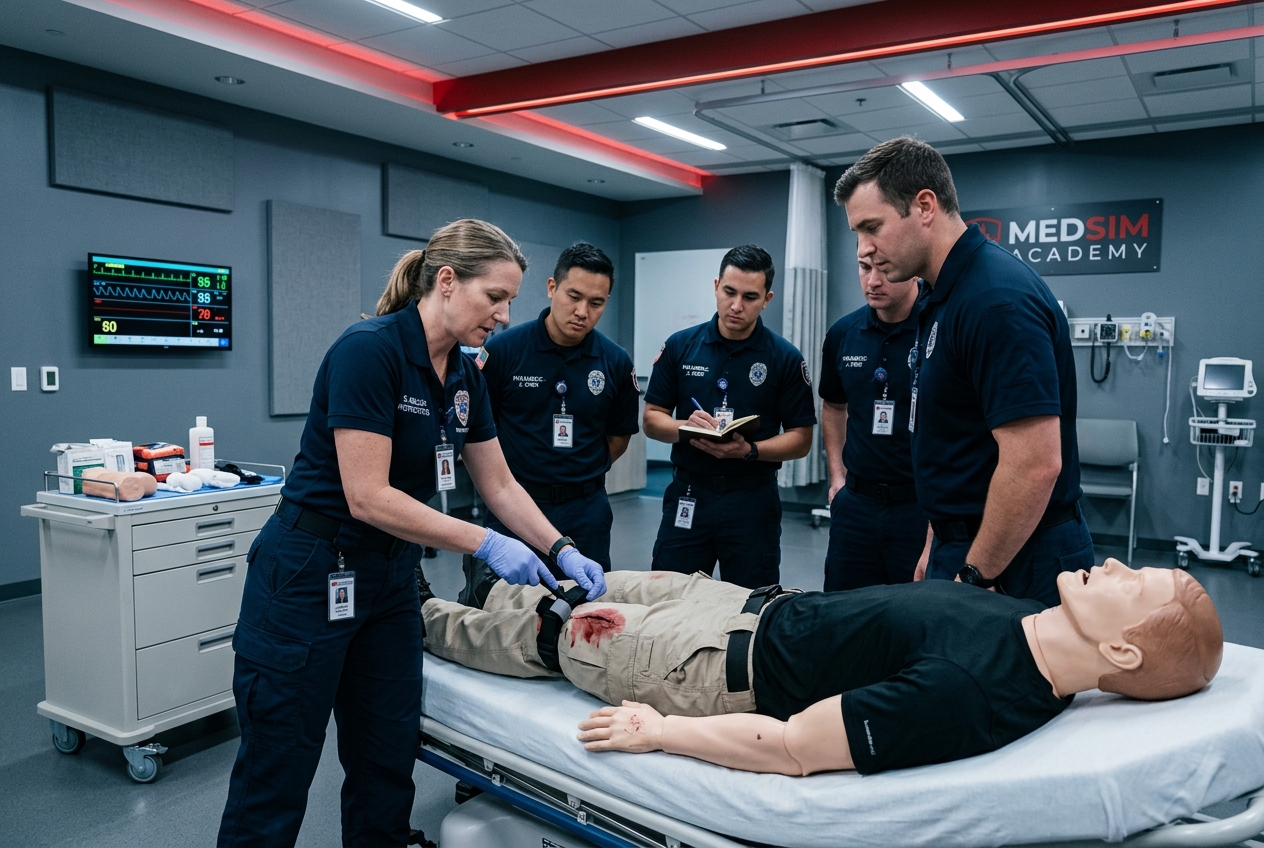 Joint scenario curriculum · Simulation
Common Readiness Crosswalk
What “ready” means, by role.
Joint Scenario Curriculum
How it is taught and rehearsed.
Readiness Measurement
What is counted, and how well.
After-Action Learning
What changes as a result.
Train-the-Trainer & QA
How quality survives scale.
 Dispatch · Common terminology · Timestamps
An 18-month, independently evaluated regional pilot.
The pilot exists to answer one question: can a shared readiness framework be implemented, measured reliably, retained over time, and accepted by the institutions that would have to live with it?
- → 3–6 founding institutions across six functional roles
- → Documented stage gates every phase
- → Independent evaluator controls the analysis
- → Bounded, reversible participation